


Mattress Gluing Lines: Adhesive Types and Application Methods
The differences between hot-melt and water-based adhesives, roller and spray application, and the criteria for choosing a gluing line.
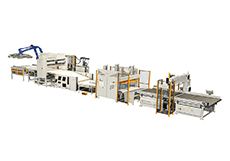
The layers of a mattress are bonded with adhesive. Laminating foam layers, surrounding the pocket spring unit with edge foams and fixing the comfort layers to the core are the work of the gluing line. The choices made at this stage affect not only the durability of the mattress but also line speed and the working environment.
Two common adhesive types
| Criterion | Hot-melt adhesive | Water-based adhesive |
|---|---|---|
| Application | Applied molten; bonds as it cools. | Applied as a liquid; bonds as the water leaves. |
| Setting time | Short; the product can move straight to the next operation. | Longer; drying or waiting may be needed. |
| Equipment | Melting tank, heated hoses and nozzles. | Pump with spray or roller arrangement. |
| Point to watch | Temperature control and open time. | Humidity, drying conditions and consumption setting. |
Which adhesive to use is decided together with the adhesive supplier, according to the materials, the certifications the product is aiming for and the line speed.
Application methods
Roller application
The adhesive is transferred to the surface as a thin, even layer by a rotating roller. Consumption is easy to control on flat, wide surfaces; this method is widely used for laminating foam layers.
Spray and bead application
The adhesive is sprayed from nozzles or laid down as lines and dots. It gives flexibility on edge foams, on the spring unit and on uneven surfaces. How much adhesive goes to which area can be programmed.
Moving from manual gluing to a line
With manual spraying, consumption and quality depend on the operator. On a gluing line the amount of adhesive, the application area and the pressing time are kept the same for every product. The direct results are:
- Adhesive consumption becomes measurable and controllable.
- Bond quality does not vary from product to product.
- Operator contact with adhesive and overspray in the air are reduced.
- Layers are aligned mechanically.
Criteria for choosing a line
- Product mix: Do you produce foam only, pocket spring or hybrid? Is foam encasement gluing required?
- Number of layers: How many layers are glued in one pass determines the length of the line.
- Pressing and waiting: The press after gluing and any waiting area are part of the line.
- Size changeover: Ask how long it takes to switch between mattress sizes.
- Cleaning and maintenance: Roller and nozzle cleaning is part of daily work; easy access shortens downtime.
- Before and after: The gluing line should be planned together with foam feeding and the closing stations that follow.
Factors that affect bond quality
- Surface: Adhesive cannot hold on a dusty, oily or damp foam surface; storage conditions for the material matter.
- Amount: Too little adhesive leads to delamination; too much leads to stiffness, longer drying and higher cost.
- Open time: How soon after application the layers must be joined varies by adhesive; line speed is set accordingly.
- Pressure: The joined layers should be pressed with even pressure; uneven pressing causes local delamination.
- Environment: Temperature and humidity directly affect drying time, especially with water-based adhesives.
Foam encasement gluing
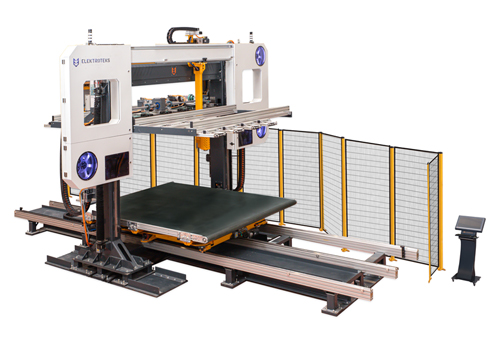
In pocket spring mattresses the spring unit is usually surrounded by a foam frame. This frame increases the edge strength of the mattress and provides a seating edge. Cutting the frame pieces to size, aligning them around the spring unit and gluing them takes time by hand and is prone to dimensional deviation. Lines that do this with mechanical alignment and programmed adhesive application both shorten the time and keep the outer dimensions of the mattress consistent.
Safety and the working environment
With hot-melt systems, protective equipment against burns and insulation of heated parts should be planned; with spray systems, ventilation and extraction. The safety data sheet of the adhesive specifies the protective equipment to be used and the storage conditions. Lines with enclosed cabins and programmed application minimise operator contact with adhesive.
Frequently asked questions
Can two adhesive types be used on the same line?
Some lines can be set up to work with different adhesive types at different stations; for example roller application for layer lamination together with nozzle application for edge foams.
How is adhesive consumption monitored?
With programmed application the amount per product is known; comparing tank consumption with the number of units produced reveals deviations early.
Can a glued mattress go straight to the next operation?
That depends on the adhesive type and the pressure applied. With fast-setting adhesives the product can move on directly; with others a short waiting area is planned.
You can review the solutions on the gluing machines page.
- mattress gluing line
- mattress lamination
- hot-melt adhesive
- water-based adhesive
- foam gluing
