


Mattress Border and Tape Edge: The Operations That Define the Finished Look
How the border is prepared, what a tape edge machine does, and what determines quality and speed at these two stages.
Anyone looking at a mattress looks at the edges first: a neat border and an unbroken edge seam give the impression of a carefully made product. Border preparation and tape edge closing are the two stages of mattress production where manual skill matters most, and therefore where the machine needs to support the operator most.
What is the border and how is it prepared?
The border is the strip that surrounds the side of the mattress. It is produced on a separate branch from the top and bottom panels, and several operations come together on it:
- Border quilting: Fabric, fibre and backing are stitched together to give the border volume and pattern.
- Cutting to length and joining: The border is cut to the perimeter of the mattress and closed into a loop.
- Handle sewing: Handles are added for carrying and turning the mattress.
- Ventilation: Air vents or mesh strips are fitted to let air pass.
- Zipper: On mattresses with removable covers the zipper is sewn to the border.
- Labels and ribbons: Brand ribbons and labels are added at this stage.
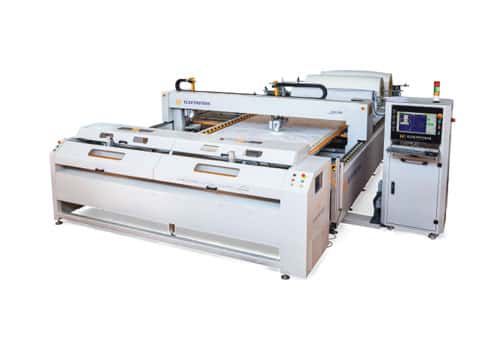
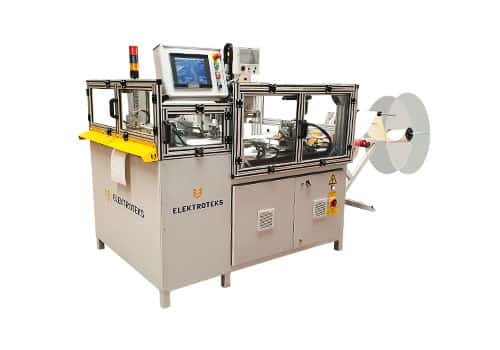
Doing these operations at separate workstations can turn the border into the bottleneck of the line. Machines that combine operations in a single pass reduce handling and intermediate stock: border machines.
What is tape edge closing?
Tape edge closing is the operation in which the panel and the border are sewn together with a tape. The sewing head travels around the perimeter of the mattress; at the corners either the mattress or the head turns. After the top side is closed, the mattress is flipped and the bottom side is closed.
What determines quality in tape edge closing
- Corner turns: Coordinating speed and rotation at the corners is decisive for a wrinkle-free corner.
- Mattress height: For high mattresses the angle and height of the sewing head should be easy to adjust.
- Material feed: If the panel, border and tape are not fed at the same tension, the seam becomes wavy.
- Flipping: Turning the mattress by hand is both a time and an ergonomics problem; machines with a flipping system reduce the load on the operator.
- Operator assistance: Aids such as automatic speed adjustment and corner detection make it easier to get a neat result even with a less experienced operator.
Why is this the bottleneck on most lines?
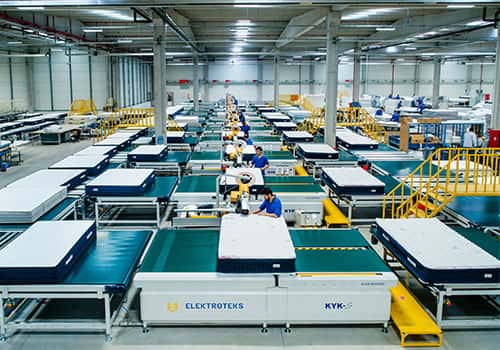
Quilting and gluing largely run at machine speed, whereas tape edge closing depends on the skill of the operator. As trained operators become harder to find, machines that automate corner turning and flipping become the way to keep the line balanced. When planning a line, the number of tape edge stations should be calculated against the quilting and gluing capacity.
Checklist
- Is the seam continuous and evenly spaced around the mattress?
- Are there wrinkles or puckering at the corners?
- Does the tape grip the panel and the border equally on both sides?
- Are the handles and vents symmetrical?
- Is the mattress height the same all the way round?
Trends in border design
The border has become an area where brands differentiate their products. Three-dimensional mesh (3D) strips increase airflow while adding a visual accent; strips in contrasting colours, embroidery and brand ribbons make the side view of the mattress recognisable. As the design becomes richer, the number of operations on the border increases, making the border one of the parts with the most sewing labour per mattress. Machines that combine operations in a single pass therefore provide not only speed but also design freedom.
Choosing tape and thread for tape edge closing
The edge tape covers the seam and protects the corner. Its width must suit the corner radius of the mattress and the thickness of the layers; a narrow tape cannot grip thick layers, and a wide tape puckers at the corner. For thread, breaking strength and abrasion resistance matter, because the edge seam is one of the most stressed seams over the life of the mattress. Matching tape, thread and needle reduces skipped stitches and thread breaks.
Ergonomics and operator health
Flipping by hand and constantly steering the mattress put a load on the operator's shoulders and back. A height-adjustable work table, an air-cushion or conveyor table, automatic flipping and a sewing head that slows down by itself at the corners reduce both fatigue and the error rate that rises towards the end of the day. This equipment also helps new operators become proficient sooner.
Frequently asked questions
Is chain stitch or lockstitch used for tape edge closing?
Both are used. Chain stitch suits uninterrupted running; lockstitch is more resistant to unravelling. The choice depends on how the product is positioned and on production volume.
Can very high mattresses be closed?
It depends on the working range of the machine. If you produce high mattresses, state the required height and angle adjustment range of the sewing head when choosing the machine.
How many mattresses does an operator close per day?
It varies with the size and height of the mattress, the equipment of the machine and the experience of the operator. A sound comparison requires a trial with your own product.
For tape edge and line solutions, see mattress machines.
- border machine
- tape edge machine
- mattress closing
- mattress sewing
- mattress border
